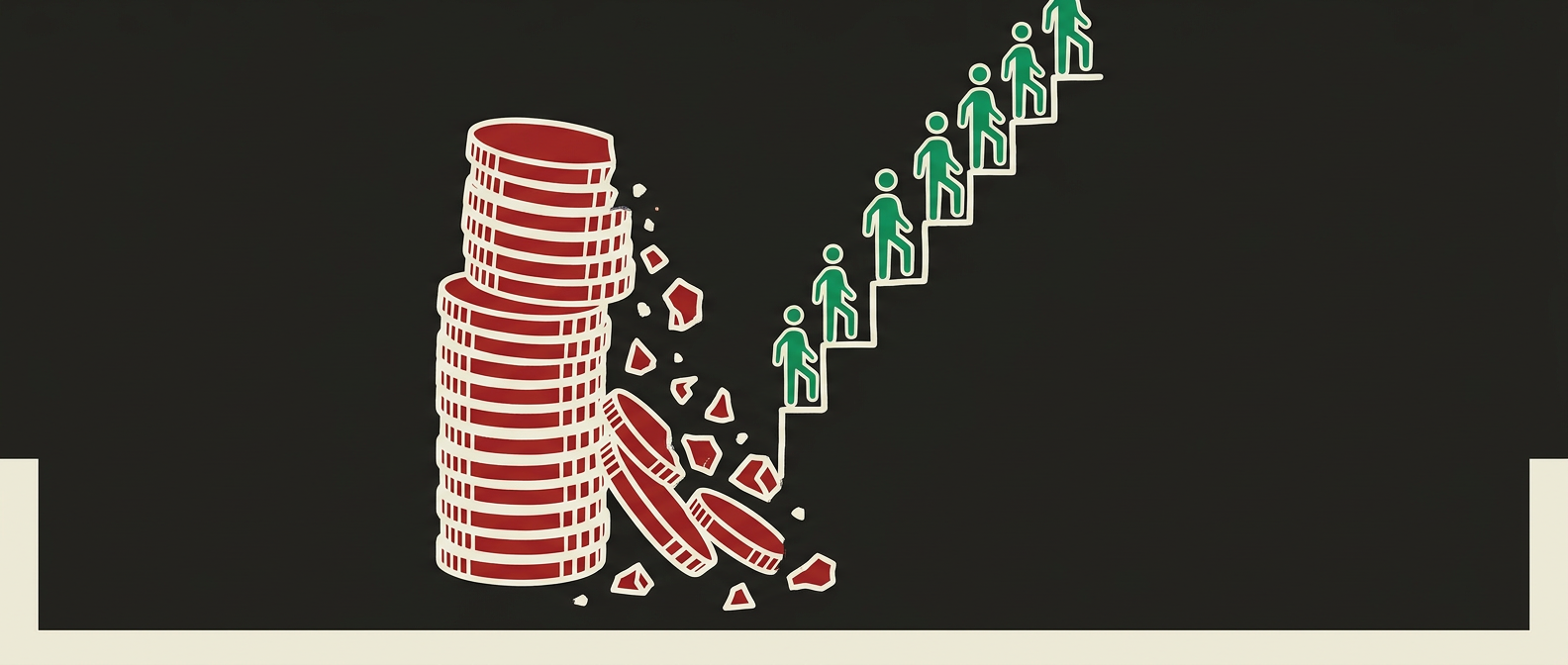
Money Won't Matter. Except When It Does.
BLUF: Elon Musk says AI abundance makes money irrelevant by 2036. Sam Altman, weeks after his own company published a policy paper urging shorter workweeks, said on a podcast that AI won't shorten anyone's workweek, because people never stop competing. Both statements can be true at once. The reconciliation matters more than either claim alone, because it tells you what the next decade actually rewards.
The Musk claim
Money is only useful for buying goods and services. If robots and AI make goods and services so abundant that output exceeds anything a person could consume, money's core function collapses. Musk's proposed fix, offered in conversation with The Economist: have the treasury simply issue checks. The standard objection is inflation. His counter is that inflation is just the ratio of money to output. If output grows faster than the money supply, you get deflation, not inflation. Print money, but print it slower than production grows, and prices fall.
That part is not radical economics. It's the same logic behind the mild deflation the US economy ran through from the 1870s to the 1890s, when industrial output outran a gold-constrained money supply. Musk isn't inventing a new law here. He's betting an old one holds again, powered by robots instead of railroads.
The bet has a hole in it. Software scales at close to zero marginal cost. Physical robots don't. They need materials, energy, actuators, maintenance, supply chains. Tesla's own Optimus, the flagship proof of the abundance thesis, has spent the past year well short of its own targets. Tesla aimed at roughly five thousand units in 2025 and built a few hundred, with about three hundred deployed inside its own factories as of the Q4 earnings call. Rare earth export restrictions, a hand redesign, and supplier qualification all ran longer than planned. Note what that number is and isn't: robots working in the factory of the company that builds them, not robots sold into an economy. The theory is sound. The hardware to make it real is running years behind the rhetoric.
The Altman claim
Speaking on a podcast in late July, OpenAI's CEO said AI won't produce a four-day workweek at scale, because it never has, no matter what the technology. People raise their ambitions as fast as their tools improve. It's a relative game: people track their position against everyone else, not their distance from some absolute standard of "enough." Productivity gains turn into new goals, and rarely into more leisure.
This isn't a new observation either. Keynes made almost the identical prediction in 1930, forecasting a fifteen-hour workweek within a century on the strength of productivity growth alone. It never arrived, for the reason Altman just restated. A large share of human effort chases relative position, not absolute need. Economists later called this class of goods "positional." Status, rank, being ahead of the person next to you. Material abundance doesn't touch that kind of scarcity, because it was never a material problem to begin with.
What makes Altman's comment sharper than Keynes's is the source. In April, his own company published a thirteen-page policy document, Industrial Policy for the Intelligence Age, proposing government-backed pilots of a thirty-two-hour workweek at full pay. Critics called the proposal weak at the time, since it asked governments to run trials rather than requiring employers to do anything, nowhere close to a binding agreement like Germany's union-negotiated thirty-five-hour week. Three months later, the same CEO said the market won't deliver shorter hours on its own. He confirmed his own critics before they had to say it twice.
Reconciling the two
These aren't actually in conflict. Musk is making a claim about prices. Altman is making a claim about hours. Both can hold simultaneously: prices on today's goods and services fall as production outruns the money supply, while total human effort doesn't fall at all, because that effort gets redirected toward newly invented forms of competition rather than absorbed as leisure.
What both men are quietly assuming, and what neither has really defended, is that the scoreboard stays money and productivity. That's the weaker part of either argument. History suggests otherwise. Wherever a society has removed material subsistence as the binding constraint, status competition has relocated rather than dissolved, to honor, to craft, to spiritual rank, to whatever still confers relative standing. If AI abundance genuinely removes production as the primary site of competition, the drive doesn't vanish. It goes looking for a new arena.
The part neither man is pricing in
There's a geopolitical version of this same asymmetry problem. If abundance arrives unevenly across nations rather than everywhere at once, the dangerous window sits in the middle of the race, not at the settled endstate. Power-transition theory backs this up. Stable, wide gaps, where one side is durably ahead, don't reliably trigger conflict, because the weaker side can't contest it. Volatility comes from a gap that's narrow, contested, and perceived as closing, since that's when preventive action starts looking rational to whoever fears losing the race. Two labs and two nations racing toward the same threshold, each uncertain who gets there first, is close to the worst-case stability profile.
What actually changes
The competitive drive itself looks permanent. It shows up in hunter-gatherer bands with no material scarcity problem relative to their needs, who still built elaborate status hierarchies around hunting skill and storytelling. Most consumption in wealthy economies today is already positional, a point Veblen made over a century before anyone was talking about robots. AI abundance was never going to solve a problem that was never really about material scarcity in the first place.
What isn't fixed is the intensity, or the arena. Culture and institutions can dial the competition up or down even if they can't delete it. And this is the actual target of a much older project than either Musk's or Altman's. The Stoics didn't think the drive to compete could be deleted either. What they aimed at was decoupling your own sense of worth from the external ranking, so the game stops running you even while it keeps running around you. That works at the level of one person. Nobody has ever gotten it to work at population scale.
BLUF, restated
Musk is right that abundance can make prices fall. Altman is right that abundance won't make anyone work less. Neither of them has an answer for what happens to status competition once the material floor rises for everyone at once, because that was never the AI question. It's the oldest question there is.
Stay in the loop
One dispatch per week — what I shipped, what broke, and what I learned from the field. No filler.
What should I write about?
Got a topic you'd like me to cover? I read every suggestion.