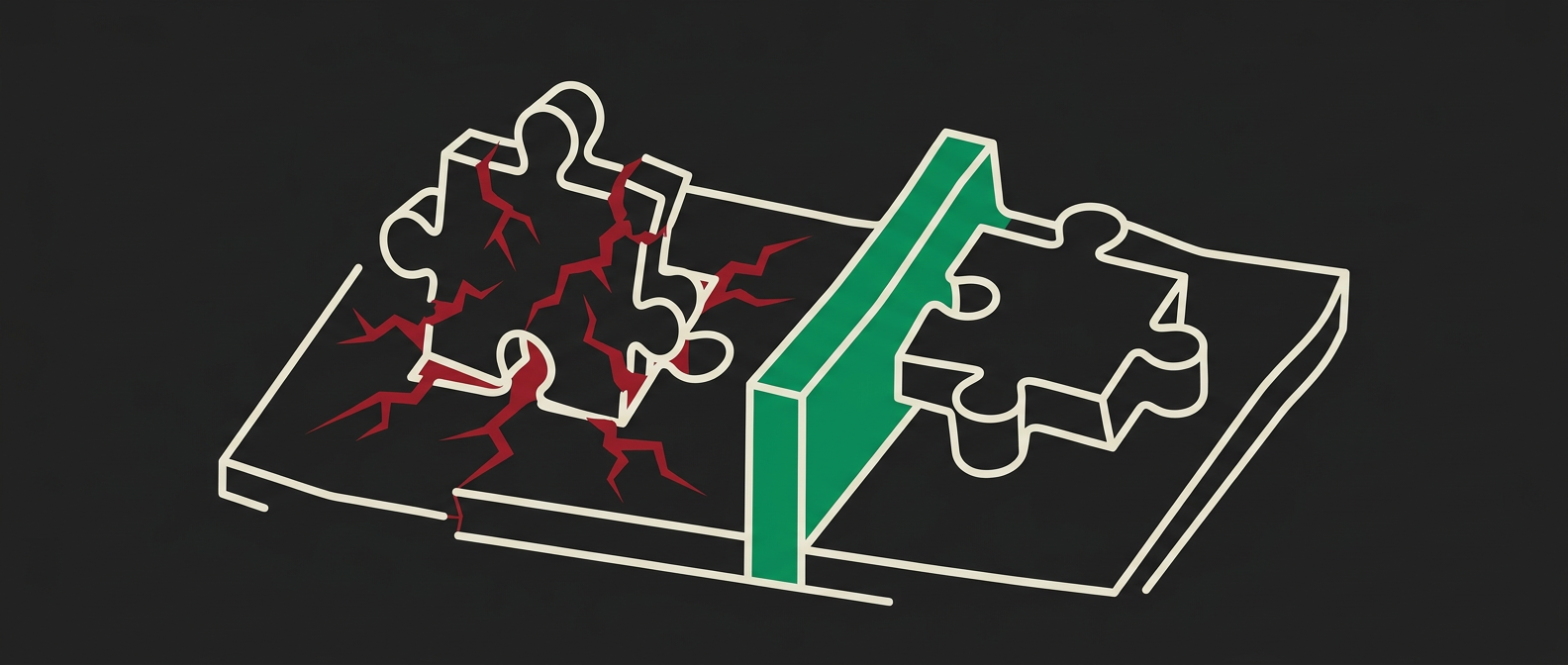
A patch that applies is not a patch that is correct
A new paper on Kubernetes config repair contains one number that should bother anyone running an agent that edits files without a human watching: when a tolerant patch tool is handed LLM-generated unified diffs, it applies 96% of them and silently misapplies about one in seven.
Not rejects. Applies, reports success, and puts the change somewhere it does not belong. No error, no exit code, nothing downstream to catch it.
The paper is Don't Let the Model Write the YAML by Pruthvi Davineni, published August 31. It evaluates the obvious way to build an incident-remediation agent in a GitOps workflow: have the model author the edited manifest or a diff against it, then apply that text. Every practitioner reaches for this first because it is the shortest path from "the model knows the fix" to "the fix is in git".
The result that looks bad is the safe one
Under strict patching, almost none of the model's unified diffs apply at all. Read quickly, that sounds like the damning finding. It is the opposite. Strict patching fails loudly, in the one place a failure is cheap: before anything is written.
The damage happens when you reach for GNU patch to make the pipeline work. Fuzz is what takes a 0% apply rate to 96%, and fuzz is precisely the mechanism that converts "this hunk does not match" into "this hunk matched something close enough". The tolerance that makes the system look functional is the same tolerance that makes 14 to 20% of its edits wrong in a way nothing reports.
This is where the finding stops being about Kubernetes. Most coding agents in production apply edits through some form of forgiving string match, because exact-match editing fails constantly against a model's approximate memory of a file. That forgiveness is load-bearing. It is also the reason your agent's success rate and your agent's correctness rate are two different numbers, and you are almost certainly only measuring the first one.
Full-file rewrite is not the way out
The other common answer is to skip diffs entirely and have the model emit the whole corrected file. The paper finds this is capability-dependent in an awkward way. A small model corrupts the file outright, which at least tends to be visible. A frontier model is usually correct, and non-deterministic: on some runs it silently drops a field or edits a neighbouring one.
"Usually correct and occasionally silently wrong" is the worst property a component in an unattended loop can have, because it defeats testing. You verify the edit path, it passes, and the next invocation on the same input behaves differently. It also costs O(file size) in generated tokens for every edit, so the price scales with the file you are touching rather than the change you are making.
The idea worth stealing
The fix is a separation, and it transfers well beyond YAML: split the semantic decision from the syntactic act.
The model emits only a structured intent. Which resource, which field, which value. It never produces file text. A deterministic pipeline then indexes manifests by (kind, name), uses the YAML parser's node position marks to find the exact character span of the target scalar, and replaces only that span in the raw bytes.
Because the file is never re-serialised, the diff is minimal by construction. Comments and formatting survive. The edit is correct and identical on every run regardless of which model proposed it, at O(1) generation cost. The author calls the pairing a fail-closed application contract, which is the phrase to remember. In an unattended loop, a tool that refuses is worth more than a tool that copes.
What it does not claim
The scope statement is explicit and worth quoting: the claim covers faithful application of a known change; whether the change is right is left to human PR review.
That honesty is what makes the result usable. This does not make remediation agents safe. It removes the failure mode you cannot see and leaves the one code review is actually good at catching. Wrong-value-in-the-right-place shows up in a diff. Right-value-in-the-wrong-place, applied by a fuzzy patcher into a neighbouring resource, produces a plausible-looking diff that a reviewer skims past.
Two limits I would hold onto. First, this is a single-author eight-page paper with one benchmark over Kubernetes manifests. The one-in-seven figure is a measurement of that setup, not a constant you can quote about patching in general. The benchmark and implementation are both Apache-2.0, so the number is at least checkable, which is more than most agent-tooling claims offer.
Second, and more likely to be over-read: this works because manifests are addressable. There is a stable identity key, a parseable structure, and a target that is a single scalar with a known character span. "Refactor this function" has no equivalent. Anyone concluding that agents should never generate code text has taken the result somewhere it does not go.
The narrower reading is the useful one. For each edit your agent makes, ask whether the change is expressible as a structured intent over an addressable target. Where it is, stop letting the model write the text; that class of edit can be made deterministic today and there is no reason to keep paying for the tokens or the silent errors. Where it is not, you are still in the fuzzy-patching regime, and the thing to do is know it and instrument for it, rather than reading a 96% apply rate as a 96% correctness rate.
Source: arXiv:2609.00227, Pruthvi Davineni, 31 August 2026.
Source: https://arxiv.org/abs/2609.00227
Stay in the loop
One dispatch per week — what I shipped, what broke, and what I learned from the field. No filler.
What should I write about?
Got a topic you'd like me to cover? I read every suggestion.